Showing posts with label dinghy. Show all posts

Saturday, June 6, 2015

Rainy Hampton Roads

It was time to give up our nice free spot in Portsmouth to some other deserving cruiser. Unfortunately, we hadn't come up with a better plan so we really didn't have a destination in mind.  I looked around and found a small anchorage in Hampton that claimed to have free WiFi and a nearby dinghy dock.  This sounded like as good of a place as any to hang out for another night or so as we continue working on the plan for the next couple months.

An interesting replica ship we ran across at Hampton Roads
The past few days have been sunny and hot, but we awoke this morning to overcast skies.  It is interesting, but the last time I was here it was nice when I arrived and rainy when I was departing north.  In any case, we untie the lines and, after determining that the tugs playing around the battleship across the river were not going to be in our way, we departed.

Small Anchorage. Image from ActiveCaptain
It was a short trip down the Elizabeth river, across Hampton Roads, and up the Hampton River. When we got to the anchorage location, we found a very small area with a string of crab pots going through it.  Even though it was a nice location, we decided there just wasn't enough room for our catamaran. We decided the other options that were marked up in this river were likely not any better and decided to go to an anchorage we heard of near Fort Monroe.

Fort Monroe Anchorage - Image from ActiveCaptain
This anchorage sits between the Hampton Roads beltway and Fort Monroe so we didn't expect much quiet but it actually was.  It was also pretty well protected from north through east winds, but some waves seem to sneak in from the south.  Just after we dropped the anchor, the rains started.

Wall of Rain Approaching
It rained on and off for the next 3 days...mostly on.  But we were still able to launch the dinghy and take the dogs exploring at Fort Monroe.  This was the first time the dogs had been in the dinghy, and I'm not sure they enjoyed the ride.  Maybe they just hate the life jackets, I'm not sure.  They did enjoy getting off the boat and roaming around the fort.

Ft Monroe Lighthouse

Dogs exploring the fort with us

View of the Chesapeake from the fort
We were able to come up with a new plan as well.  We have decided to go to a marina here in Hampton Virginia for a little while so we can sort out our cars (and maybe get them sold), have family come visit, and get some work done.  Then we will make our way to a yard to get the last few bigger items done.  At least that is what we have scribbled in the sand for now.

Saturday, April 12, 2014

Another Impeller!

In my last post I mentioned that I've been focusing my recent attention on my dinghy (a.k.a. family car).  While I work on the registration and debate the best way to fix the leaks in the Caribe RIB, I figured I would look over the motor and see if I can get it running.

The motor is a 15 hp, 2-stroke Yamaha engine.  Using a manual I found online (the previous owner didn't leave me the hard copy), I opened it up and went through all the basic checks to make sure the controls work and it had at least a reasonable potential to start.  While mounted on the storage mount, I hooked up the gas tank and a clamp-on adapter to provide fresh water for cooling.

It took a couple tries, but the motor did fire up.  Of course, the stream of cooling water failed to appear from the appropriate hole in the motor housing where it is supposed to be found.  Since running the engine without cooling water is very bad, I quickly shut down the engine.  With my recent impeller experience, I figure there is a very good chance that this is the problem.  Now, where do they hide the water pump on an outboard motor?

Looking through the manual, I found that the water pump is actually located in the lower end of the motor on the drive shaft.  I guess it makes sense, but it certainly isn't a convenient location for checking the impeller. Guess I will need to disassemble the engine just to check and see if my suspicions are correct.  As I've learned to do, I consult Google and YouTube for additional information on the process and I found this video that demonstrates the general process.


A little more complicated than replacing the impellers on the inboard engines, but it doesn't seem too bad. I locate the impeller (actually a kit, more on that below) at a local store and begin the process of checking and changing the impeller.

Motor on the cockpit table...where else would you work on it?

I remove the lower unit containing the transmission and the water pump housing just like it shows in the video (except I disconnected the transmission linkage before I removed the other bolts).  I disassemble the water pump and viola, the culprit of my lack of cooling water is found.  Another destroyed impeller.  As I've learned, it is very important to locate all the pieces of the impeller and I dig through the passages and am able to find enough rubber bits to account for the entire thing.

Disassembled pump, another destroyed impeller found.

Yamaha did something kind of clever with the pump.  Instead of just providing the impeller, they provide a kit that contains not only the impeller, but also replacement walls for the housing and a few other bits so you can rebuild the water pump and all of the working surfaces are new.  They do this with simple stamped metal parts so the entire kit costs about the same amount as a single impeller for my Westerbeke engines.

New shiny pump walls.

With a refurbished pump, I reassembled the motor.  I did check the lower unit (transmission) oil before reassembly.  With everything back together, I put the motor on the storage mount, hooked everything back up and gave it a try.  As soon as the motor fired, a good stream of water came shooting out of the motor housing just like it was supposed to. Another impeller problem solved.

Of course the engine only ran for a minute or so and then sputtered to a stop.  I probably need to get some fresh gasoline, but at least now I know the motor does run and seems to be in better condition than I suspected might be the case.

Tuesday, April 8, 2014

The "Car"

Living in a house on land, you generally have a car (or two....or three).  When your house is a boat floating on water, you have a dinghy or tender...and they are often referred to as the family car.  You can probably imagine that a dingy is a handy thing to have.  When we purchased our Leopard 38, it came with a rigid inflatable dinghy and a motor.

The "car" hanging on the back of the "house".

The dinghy wasn't in the greatest shape.  In particular it has a rather ugly patch that slowly leaks and the tube fabric is looking rather worn and...well you may have seen some of the other issues in this post.  And I have no idea what condition the motor is in.  So I've been debating how much more money I should invest in the dinghy or if I should just replace it.  I hate just throwing things away, but I also don't want to throw good money after bad. After some mental debate, I decided I would try to resurrect the dinghy.

I'm not really worried about how "ugly" it is (after all, if someone wants to steal a dinghy, do they want the shiny new one or the faded and worn one with patches...right?), I just want it to stay afloat without having to pump it back up while we are using it. Someone recommended a product that is somewhat similar to automotive fix-a-flat that sounds like it might help seal up any leaks in the inflatable tubes...so I might give that a try.  I was also talking with a guy that suggested that, particularly since we will have dogs, that we find or make dinghy "chaps" for the tubes using Sunbrella or similar fabric.  This would protect the tubes from the sun, chafing, and dog claws.

But first, since the boat will have a motor on it, we should probably register it.  Just like you have a license and registration for your car, most U.S. states require a registration for any boat that has a motor on it (this isn't an issue once you get out of the U.S.).  And just like your car, most states will recognize a registration from another state on a temporary basis. There seems to be a bit of debate on the internet over the need to register if it is strictly being used as a tender (only to go from ship directly to shore with no side excursions).  Since we will be in the U.S. for at least a little while, and we would like to use it more like the car to do a bit of sightseeing and other trips without having to "drive the house around", it seems to make sense for us to register it.

We have a bit of a dilemma, though.  You see, I technically live in Colorado right now but the dinghy will likely never be in Colorado so it doesn't make sense to register it there.  Of course, we will also be rather transient and most places seem to want a permanent mailing address and some require it to be in their state.  I don't think they'll accept "s/v Rover, Somewhere in the Atlantic, USA (sometimes)".   Of course, in a bit of irony, many states also want you to register your boat and/or dinghy if you are in their state for a given period of time (we don't intend to hang out in any one place that long).  This time seems to vary from 50 to 180 days depending on the state and is the what they use to determine your area of "primary use".  So you could easily be considered the area of primary use by several states and therefore require multiple registrations.  But without a mailing address....well, you get the idea.  It can make the head spin.

I think for now I'll try registering my dinghy in Georgia.  I'm at least here now and their registration fees don't seem too bad.  Or maybe I'll need to get one of those James Bond rotating license plate gizmos for the dinghy so I can register it everywhere as I go....yeah, right.


Monday, February 24, 2014

A Little Too Secure.

Included with the purchase of my Leopard 38 catamaran was a dinghy with a motor.  The dinghy wasn't in the greatest shape (in fact one hole appears to have been "fixed"...to use the term loosely...with some sort of caulk like sealant that looks like bird poo) but it does hold air for at least a little while.  The motor, if it works, is a 2 stroke 15hp Yamaha...something definitely worth keeping if it runs or can be revived.  When I took possession of the boat, the motor was mounted on the dinghy and both were hoisted in the davits.  The weight imbalance was causing the davit bar to bend down on the motor side, so it was time to remove the motor from the dinghy.

You can see how the davit bends in this old picture.

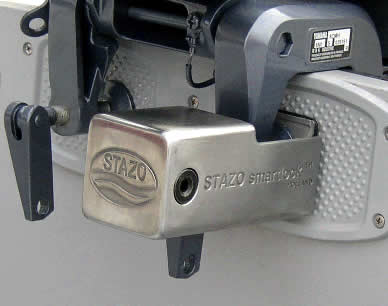
The previous owner was apparently worried a great deal about someone stealing the dinghy motor and bought a fancy lock to lock it onto the dinghy in addition to his Master Cable Lock.  The Stazo lock is a big hollow square piece of stainless steel that fits over one of the clamping arms of the motor and prevents the clamp from being set free.  I rummaged around and found the key to the lock and gave it a try.  Of course, as is my usual luck, the lock would not budge.  I sprayed some penetrating oil into the lock...and a stream of rusty oil came out.  This does not look good.  Who would make a lock for an outboard motor where the lock cylinder would rust?

Stock photo - Mine was far more rusted.

The next several days I would spray some penetrating oil into the lock and try the key...and each time the lock would not budge. A fellow boater in the marina had a die grinder and some cut-off blades, so we decided that we would take the brute force approach and cut the lock off the dinghy.  It took two cutoff blades but we were finally able to remove the lock.  Underneath the lock I found a prime example of dissimilar metal corrosion as the stainless steel lock had corroded a hole through the aluminum motor mount on the transom of the dinghy.  I had wondered why that mounting plate had looked so corroded. It is true that aluminum doesn't rust (because rust is defined as iron oxide), but aluminum certainly does corrode. The entire motor mount was rather corroded and had warped to the point that, even with the lock off and the clamps backed off all the way, we were having a hard time removing the motor from the mount.  Cleaning out the (aluminum oxide) corrosion from behind the plate we were finally able to get enough clearance to remove the motor.

Trying to remove the motor from the corroded mount.

The motor is now resting comfortably on the pushpit railing mount and I have a new project...to replace the corroded engine mounting plate on the dinghy.

Corrosion hole from the lock.

I was able to find a small, used piece of StarBoard (high density polyethylene plastic) at Sailors Exchange for a few dollars that I figure would work well as a replacement for the corroded mount.  I cut it to shape, drilled and countersunk the mounting screw holes, and viola, good as new...well...OK...not so pretty...but good enough for this dinghy.  No point throwing too much money at it when this should work for the remaining life of the dinghy.

Maybe not pretty, but a functional mount.

And below is part of the pile of aluminum oxide left behind after the replacement.  Too bad there isn't a sandpaper plant nearby...bet they would like to have it (your bit of trivia for today...some sandpaper uses aluminum oxide as the abrasive grit).

A lot of aluminum "rust" in the bottom of the dinghy when we were done.
Of course, in true boat project fashion, while working with the dinghy I found another problem.  The davit winch that spins nicely when free, squeaks under load and I also noticed the plastic stripper for the self-tailer is broken (after it tried jamming the davit line under the tab on the winch), so winch servicing is now added to "the list".  The dinghy and motor can now be separated and the davits look happier without the motors weight on them, so task completed.