Wednesday, April 15, 2020

Keeping Busy

At this time I believe that most of the U.S., despite the lack of a federal mandate,  has some sort of restrictions on the gatherings and movement of people in an attempt to slow the spread of the Corona virus pandemic.  Most have some variant of a "stay at home" or "shelter in place" order.  The result of which seems to be a lot of boredom...to the point that people are <gasp!> even cleaning their own homes.  For a boat owner, finding something to do is pretty easy.  I've heard it said many times that if you think there is nothing to fix on your boat, you simply aren't looking hard enough.  In my case, it doesn't seem to take a lot of looking.

I think I've previously written about the work that I needed or really wanted to get done before making the trip.  A few things were known and there were many more that were discovered once I returned to the boat.  In hindsight, it is probably a good thing that there were so many items that resulted in delays to the trip, otherwise my crew and I may well be stuck in the Bahamas right now or figuring out how to make a direct sail back to the U.S.  If you are curious what is going on in the Bahamas right now with regard to boaters, you can click HERE to see the current (as of 4/15/20) situation.

Work on the boat does continue, albeit at a slower pace.  Part of that is due to the fact that it appears I will have a fair amount of time before this pandemic subsides so I'm not in a particular hurry now.  Another reason is that getting supplies has been complicated by the COVID19 pandemic response and other issues. There is also the conflict between the need of help for some tasks and physical distancing requirements/recommendations. 

The first delayed project has been the rigging.  Getting the rigging at a price that wouldn't scuttle the trip before it started was one of the first delays.  Now that I have the rigging, social distancing and travel restrictions prevent any further progress on that task for the time being.

The rigging finally arrived.  180 lbs or so.
Unable to find a suitable replacement dinghy at a reasonable price, the decision was made to try and refurbish my well sunburned dinghy.  Patch material, refurbishing paint, and replacement valves were ordered.  The patch that has leaked for as long as I have owned the boat has been re-patched and now holds air and another patch has been applied.  Initial base coats of the rubber paint has been applied and the dinghy now looks significantly better and holds air.  Unfortunately more base coat was required and the new can was found to have been partially solidified when it arrived, therefore a replacement had to be acquired.  It finally arrived yesterday, so naturally it is cold, rainy, and windy outside today.  But progress will continue on that project.

Dinghy original condition.

Dinghy after first base coats of restoration paint applied.

The partial cockpit dodger/enclosure was a project that I had planned to do before getting to the boat.  A trip my wife and I made from Virginia to Southport in early January, just after completing the hardtop build, emphasized the need for protecting the helm from the weather.  The front dodger was created a little while back and is up and functional.  After completing that part, I found I had enough material to do complete panels for the sides, so I altered the design and created those side panels.  Unfortunately, I was lacking a couple of zippers to complete the build and those arrived only a couple days ago.  So, that project is almost complete, again just waiting on the weather so I can do a final fit and determine the exact position for attaching the zippers and a couple additional snaps. 

Test fitting enclosure panels.
Since it appears that I will be on the boat for a while as the temperatures rise here in North Carolina, I decided to revisit continuing issues I have had with the raw water pump for the air conditioner.  After several attempts to repair the existing pump, the motor finally seized up and a replacement had to be ordered.  As is my usual luck, despite ordering the correct pump, the one that was shipped to me was not a 115 volt A/C pump but a 230 volt one.  That had to be returned and the correct one re-ordered from a more trustworthy supplier than Amazon.  The replacement arrived about a week later and was installed and I'm happy to report that the air conditioner is again operational.  Hopefully it will stay that way for a while.

My boat was a former charter boat and was equipped with several 115 volt AC plugs, but only one 12 volt DC plug.  Since the native boat power system is 12 volt DC, it is rather inefficient to convert power from the 12 volt battery bank to 115 volt AC using the inverter and then back to  DC voltage to power things like phone, radio, and flashlight chargers.  I have now installed two new 12 volt DC sockets to provide a more efficient means of utilizing the house battery power.  With the earlier addition of solar, the boat is now more self sufficient than ever before.

New 12 volt socket with USB charger in it.
There are other projects that I initially intended to defer until after the trip that are now getting some attention while I have time.  I wasn't happy with the velcro that was used when I initially recovered the salon cushions and have since reworked those covers.  I'm continuing to retrofit some of the lights with LED strips to further  lower power consumption.  I've finally managed to identify one of the leaks the boat had during heavy rains and will be looking at repair options for it.

Social distancing and my lack of desire to go to stores any more than absolutely necessary has also given me a chance to use supplies and practice techniques that come in handy when living in a remote anchorage or on passage.  Learning better techniques to store various fresh vegetables and what can be easily frozen to extend shelf life is a continuing process. I'm also getting better at controlling the boat oven for baking more delicate items like breads.  I've even tried Nido powdered milk that came recommended at The Boat Galley and have to admit it is almost as good as fresh and certainly suitable for baking and as a coffee creamer.

Speaking of not wanting to go out shopping, since I have a sewing machine handy, I offered to sew masks for the local hospital if they were in need.  Thus far, they have not indicated a need, but I am on their list of people to contact if the need arises.  I did create a couple masks for myself for if/when I need to go to the grocery store.  One of the other boaters here at the marina has a daughter that has an immune disorder, so I also made a couple masks for them. It was an interesting exercise to try and figure out materials I had on hand that would make a reasonable mask.  What I found was that non-woven fabrics were generally considered better than woven fabrics for trapping smaller particles.  What I ended up using for my own design (again, with what I already had on board...which was very limited) was the non-woven material used in some types of reusable shopping bags for the outer layer and a cotton bed sheet for the inner liner.  Since I have a spool of stainless steel safety wire, I used pieces of it to create the bendable nose bridge.  Although I can make no guarantees about the effectiveness of the masks, I'm reasonably confident they are far better than nothing. 

So, in these strange times, I continue to keep myself busy.

Saturday, March 28, 2020

The New Normal

Well, this is certainly not a post I envisioned when I headed out to the boat to prepare for the trip to the Bahamas.  Up until recently I've been working hard to get the boat back into proper cruising shape and I think it is about there.  There is one big item left...but more on that later.

Unfortunately, while I was busy working on the boat, the SARS-Cov-2 (Coronavirus or COVID19) virus was busy spreading across the planet.  For a while, perhaps fueled by some of the mis-information that was available at the time, I had held out hope that the spread would slow or not reach the more remote places and small towns where I am or intended to travel.  Unfortunately that turned out not to be the case at all.

Around the time the replacement standing rigging finally arrived at the boat, it was increasingly evident that the trip was not likely to happen.  My help had gone back home several weeks prior while we awaited the creation and delivery of the rigging and it was obviously unwise for him to return to the boat once the rigging made it to the boat.  It also seemed like a bad idea for me to pack up, drive more than half-way across the continental United States and return home.  The idea of all that public contact by staying in hotels (if they were even open), eating fast food, and getting gas and supplies for the trip would only increase my risk of coming in contact with the virus and possibly spreading it with me.  So, I decided that I would "shelter in place" and take the time to continue working on the boat...albeit at a slower pace.

In some aspects, the cruising lifestyle lends itself rather well to physical isolation.  If you are on your boat and are well provisioned, it is fairly easy to isolate yourself from society for a relatively long period of time.  Unfortunately, if like me, you have not yet provisioned for a trip, all of the panic hoarding of supplies has made it almost impossible to provision now.  Trying to get groceries and supplies for a week or two can be an exercise in frustration.  Not only are you met with bare shelves, but physical isolation seems nearly impossible as everyone seems to crowd the stores trying to find coveted items like fresh meat, canned goods, cleaning goods, and toilet paper. Fortunately I was partially stocked for a trip with four people, so I do have enough to get by...at least until our supply chain can catch up and some of the panic hopefully subsides.

Amid all the bad panic behaviors, there is also what seems like a sizable contingent (at least here in relatively rural North Carolina) that still believe this is a hoax, or just another flu, or will somehow disappear in a few weeks, or for other reasons that escape me, seem to ignore hygiene and physical distance recommendations of the scientific community. While I'm not at anchor and completely isolated, I am glad that I am at the farthest slip out at the far end of the marina, so there is very little traffic around my boat.

My hope is to reschedule this trip once all of this blows over.  In the meantime, I have a number of projects to work on...guess that is another advantage of owning a boat in these times...there is always something to fix or improve on a boat. I should also have a bit more time to catch up on blog posts. 

Hope you are all staying safe and finding good ways to pass the time.

Monday, February 17, 2020

Power of the Sun


As I eluded to in my last post, there is one project, or upgrade, that made the list along with the repairs, and it is something that I had wanted to do since before we built the hardtop. When Doug, my crew that came to help out with some of the repairs on the boat, came up with a system that wouldn't cost too much more than the fuel I anticipated we would use with the generator on the trip (at Bahamas prices), I decided it was a worthwhile investment.  I'm, of course, talking about adding solar power to the boat.

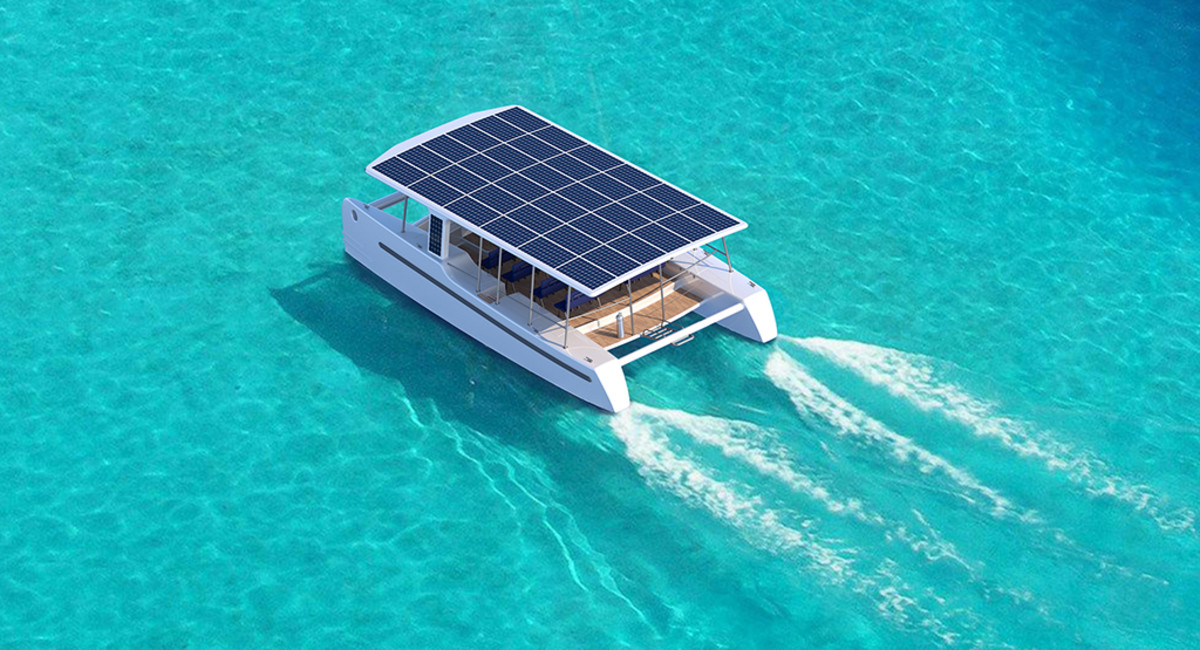
SoelCat 12, an autonomous solar electric catamaran
No, this is not my boat.

When I was designing the hardtop, I intentionally moved the sail viewing window forward just a bit in order to allow for the larger size panels you often see in residential applications as well as building in wire chases that could be used for solar.  At the time, getting panels for around $1 per watt was a very good deal.  Now the power output has increased and prices have fallen and you can get 320 watt panels that should put up with the marine environment for under $0.60 a watt.  He also found a MPPT solar controller that was getting pretty good reviews for $150.  A couple lengths of 6 gauge wire from the controller to the batteries, the special 10 gauge wire for hooking up the panels, a couple breakers, a wire gland for sealing the wire chase hole in the hardtop, a special tool for installing weatherproof MC4 connectors on the wires, and a couple other odds and ends for installation and I'd get "free" power from the sun.  Since Doug would be passing nearby the solar panel supplier on his way to the boat, it would also save me the (not insignificant) shipping cost for the panels.  The whole system would end up costing me around that magic $1/watt number that used to be reserved for just the panels.

The first step in the process, after getting all the materials to the boat, was to drill new holes in my beautiful hardtop.  Having worked so hard on that top, I had mixed emotions about drilling 5 holes for each panel in it...but if I wanted solar it had to be done.  We brought one of the panels to the boat, attached the mounting brackets to it, and marked the four mounting hole locations for each panel.  We carefully determined where the middle of the wire chase was on the underside of the top and marked the larger hole for the wire chases.  Using my drill guide, I drilled oversized holes until we reached the bottom fiberglass skin, cleaned them out, filled them with epoxy (the top is foam cored, so I needed to create a sealed "sleeve" for the holes that would also act as a compression post to tighten bolts), and drilled the smaller final size hole at each location.  It all sounds simple enough, but this is a boat project so we had to fight weather, wait for epoxy to cure, as well as other issues so making the holes ended up taking 3 or 4 days to complete.

Carefully locating the center of the wire chase.

While waiting to complete the holes in the hardtop and get the panels mounted, we installed the solar controller, breaker, and wiring from the controller to the battery bank.  The solar controller and breaker were mounted in the engine room next to the original battery charger for the boat. The wiring was run from the large main bus bars below the main electrical panel (think of a bus bar as the extension of the positive and negative posts of the battery bank), through the breaker, and on to the controller.  The controller connection was another interesting problem to solve.  Our calculations showed that we should use 6 gauge wire for the charger, but the charger terminals would fit at most a 9 gauge wire (remember the larger the gauge number, the smaller the wire).  Since the controller is rated for 60 amps, it has two connectors for each of the positive and negative battery outputs and the instructions said to run two wires to the battery...probably done to save in production costs of the charger.  Well, I didn't want to double up wires. It turns out if you take a 6 gauge wire, strip off the cover, divide the wire strands in half, and re-twist them into two conductors you end up with two 9 gauge wires.  So, that is exactly what we did to the end of the 6 gauge wire cable.  Marine grade wire cables use thin diameter strands of wire for the conductor (for added flexibility) so it was a fairly easy process. Seal it all up with quality adhesive lined heat shrink tubing and viola, a custom single cable that hooks up to the controller. A few zip ties and zip tie mounts and the cables were installed.


Drilling and filling holes in the hardtop.

Once all the holes in the hardtop were ready, we mounted the solar panels and sealed the top sides of those holes with butyl tape.  We then used an electricians fish tape to pull wires from each of the solar panels through the unsecured gland boxes, the chases in the hardtop, and to the access panel in the top corner of the targa (arch at the rear of the boat).  There we used two Y adapters to connect the solar panels in parallel and ran the resulting single set of wire down the rest of the arch, into the engine room and over to the controller.

Making the custom connection wires.

After wiring the controller up, were now ready for a test.  Of course, we were ready at about 5pm and the sun was a short time away from setting, so this wouldn't be a real test of power generation, but it would be enough to verify everything is hooked up and working.  We flipped the breaker on the battery connection and the controller came to life and recognized it was connected to a 12 volt battery bank.  A few parameters were set in the controller and then the solar panels were connected.  We have power generation!  It was only about 150 watts coming from the panels and a couple amps going into the batteries (I don't recall the exact numbers), but it was proof that the system works.

Solar controller mounted next to the original charger.

The next day we did a second test.  It was fairly sunny and right around noon and....wait a minute.  It was only showing 150 watts from the panels and under 10 amps going into the batteries.  Oh yeah, need to turn off the regular charger and drain the batteries a bit...it was doing a constant voltage topping charge because my regular charger was taking care of the batteries while I'm plugged in at the dock.  I used the inverter and a space heater to pull some energy out of the batteries and then tried again.  That's more like it.  Even with the boat sitting so that one panel tilts a bit north and the sun was at best about 45 degrees from overhead, we were seeing 460 watts coming from the panels and 31 amps (at proper charge voltages) going to the batteries. Yay!

Data from the Android App.

I finished tidying up the wiring and checked the connections with my non-contact thermometer to make sure there wasn't any resistance causing heat build up.  We then reinstalled all the access panels and I glued down the wiring glands on the top so it is again waterproof.  The only thing left to do on the install is figure out some sort of skirting for the panels so lines don't accidentally get hung up under the panels.

Panels Installed except for line deflection skirting.

In the days since the initial install, I have run a number of other tests and found that, as long as I'm not running electric heaters or air conditioners, the setup seems to keep the batteries charged.  Of course the real test will be sitting at anchor when I have to use the inverter (or...shudder...the generator) for 120 volt AC service. 

I also found a glitch in the solar controller.  It was rarely going into its float charge state.  I contacted their technical support (which only seems to be available via e-mail) and found that the charger has a hard coded value for the switch over point from topping charge to float charge and doesn't take into account the recommendations of most of the battery manufacturers or size of the battery bank.  For most solar installs that have loads that take power most of the time, this isn't really an issue as charging time is limited by sunlight hours.  The only time it comes into play is when the battery is fully charged and there isn't a load (like a boat in storage). I was informed that, at the price point of the charger, the manufacturer would not change the programming of the device to better align with the lead acid battery manufacturer recommendations. Fortunately there is an easy work-around by simply setting the controller to limit the charge voltage to the lower values used for float charging when the system isn't actively used.  With the WiFi feature of this controller, it is easily done.  Not the ideal solution, but good enough for my purpose.

Overall I'm happy with the result.  One of the things I really hated was to have to start the generator in an otherwise peaceful anchorage in order to recharge batteries.  With this addition, I hope I won't have to do that very often.  Not having to burn fossil fuels in order to produce energy is also a good feeling.


Friday, February 7, 2020

If it ain't broke...it ain't a boat

Work on boat projects continue.  Spending a bit of time on the boat, we've run across a number of items that were, after two years of sitting alone, were need of repair or replacement.

Things like interior lights and the stereo are not really mission critical systems, but enhance the utility and enjoyment of the boat so they are getting replaced.  The water heater, also not critical, was leaking our fresh water supply so it obviously needed to be repaired or bypassed. The sump pumps are a bit more critical, so they too required attention. The dinghy, aka the family car, is a must have as basic transportation.
The installed new water heater

New USB/Bluetooth stereo
Something I seem to have forgotten but have definitely been reminded of is that it always takes longer to do a task on a boat.  Cramped spaces, a rocking platform, limited tools and supplies, the "creative" solutions of prior owners or maintenance people and the weather all play a part in slowing down what would be an easy task on land.  On Youtube there are many helpful videos on maintenance, but the videos are usually shot in a nice studio with plenty of lighting and the part in question (usually a brand new example of the part) sitting neatly on a bench.  I would love to see a video where the demonstrator was busting their knuckles on bulkheads and other sharp objects trying to access the part...then I'm sure the videos would be much longer with a lot of "colorful metaphors" being beeped out in post production.  They would also be more of an accurate representation of how the process goes.  Oh well, at least there is some instruction available.

Yeah...how about you demonstrate on mine...
...and I consider this pretty accessible. The mounting
screws are right behind the big waste hose.
One critical system that was questionable was the standing rigging.  The wires that hold the mast up and make this a sailboat are pretty critical as you definitely don't want it to come crashing down while on passage.   Weather had been playing a part in delaying the inspection as one doesn't want to be freezing and flapping around in the wind while attached by a rope to the top of the mast.  About a week ago, I was finally able to go up and do an inspection.  Unfortunately, what I found only confirmed my fears of what I thought I had observed via binoculars from the dock.  There was some surface corrosion (which in itself isn't necessarily bad), but there was also some rust lines that follow the strands of the wire (called candy caning as it looks like the twisted stripe of one), a small amount of pitting, and a few small bulges in the thickness of the wire.  The latter are indications of corrosion taking place in the inner strands of the wire.  So, it looks like replacement is necessary for safety.

Yeah, gotta replace those wires.
Trying to measure the rigging so I can order replacements is also not the easiest of tasks.  Ideally, the mast is unstepped and the rigging cables can all be taken to a shop, measured, and replacements constructed.  Since there is no place nearby where I can get a crane near the boat in order to take down the mast, we will be doing it once piece at a time while the mast remains standing.  This means ordering the cables with special fittings on one end so the cables can be cut to the final length and the fitting installed at the dock.  Doug, the crew member that graciously offered to come down to help, and I took turns going up the mast in order to get the measurements.  Thanks to the weather and some technical challenges in measuring wire paths while dangling nearly 60 feet up in the air, it took two tries over three days to get the measurements done.  But we did get them and were now armed with enough information to order replacements.

Inspecting the rigging on a less than ideal weather day

Doug took a selfie up the mast on a nicer day.
Previously, primarily as an overabundance of caution, I had looked into replacing the rigging.  What I had found was that some riggers were unable to even source some of the parts required and others were unable or unwilling to work with the special cable used to rig the boat (swaging fittings on compact strand wire is more difficult due to the "compactness" of the cable).Being the DIY type of person (if you aren't DIY, you had better be rich to own a boat) who wants to cut the rigging to exact length and install boat-side, I am also looking for swageless terminals to avoid the swaging issues.  Looking into sources for rigging, I quickly ran into similar problems.  I currently have a call in to the original manufacturers of the rig and it sounds like I may be able to get the parts directly from them...in South Africa.  I've been told, if they have the parts the turn-around time on an order should be under a week...now I just need to figure out what it will take to get it half way around the world.  Unfortunately, communications have been slow with them.

While I await answers on the rigging, a number of things are getting done.  The two manual emergency bilge pumps were disassembled, cleaned, reconditioned, and are now effectively pumping water.  All the winches have been serviced.  The dead stereo has been replaced with one that now supports bluetooth streaming as well as USB thumb drives for music sources. A newly discovered glitch in the refrigerator was researched and "repaired" by simply exercising the thermostat control.

Not everything is repair.  I finally came up with a design for a simple replacement dodger that deals with the issue of strange angle of the mounting of the main sheet winches.  I was even able to get a good deal on the Sunbrella material needed to make the dodger and get other items ordered.  There is one other project in the works, but I'll save that for another post.  It is something I had planned to do a while ago and I think it will be of great benefit for the trip.

So, the work continues...but hopefully I'm seeing a light and the end of the tunnel and am really looking forward to some relaxing time in the Bahamas.

Tuesday, January 21, 2020

Fixin' Things

Sometimes I wonder if I shouldn't have called this blog "Fixing my boat in every location" as I think the majority of my posts deal with boat maintenance and repair.  And this one will be no different.

Having been unable to get out to the boat for almost two years left the boat gremlins plenty of time to break things.  I was actually fairly surprised that I haven't found more problems, but still have more than enough to keep me busy.  Fortunately one of my crew, Doug, joined me a week ago and he has been a great help as we tick things off the list.

As previously mentioned, one of the bigger items I found during my initial inspection of the boat was a leaking water heater.  Doug picked up a new one while en route to the boat, saving both shipping time and cost.  A few days ago we removed the old water heater and installed the new one.  A quick pressure test and....oops, forgot one hose clamp.  A second pressure test with the hose clamp installed and all is well in the fresh water system again. 

Of course, the leaking hot water heater did do us a bit of a favor by showing us that the electric bilge pump in the engine room was not working.  We discovered the float switch had broken free of its mount and was...well...floating.  After pumping about 14 gallons of water out of the bilge, my crew member was gracious enough to volunteer to work on that project (and having spent a lot of time in that engine room, I was happy to take him up on the offer).  He diagnosed that the problem with the system was that the float switch was not working as well as needing a new mount.  We decided to construct a new mount that would allow for easier maintenance, similar to the mount in the port engine room.  The new switch is now held securely in a new mount behind the engine where it belongs.

Mid "MacGuyver-ing" the new float switch mount.
No, the final version uses bolts and not electrical tape

I would like to say we gave the old water heater a fond send-off...but this thing has now tried to burn down my boat and sink it.

Mr. Broken Heater, meet Mr Dumpster.

Another maintenance item related to fresh water system was to clean and sanitize the fresh water tanks and lines.  This is a relatively simple, if not time consuming process of pumping the existing water out of the fresh water tanks, filling them up with new water, adding a little extra bleach to the mix, and running that solution through all the pipes.  Over the course of the past week and a half that was done (211 gallons is quite a bit of bleached water) and, after obtaining a new water filter for the under sink filter, the water on board is deemed once again safe.

We have had some wins in the maintenance department as well.  Another bilge pump, the main one in the port hull was inoperative but after disassembly and cleaning, we were able to get it running once again.  The raw water pump for the main reverse cycle air conditioning unit was also not working, but after removing the pump head, cleaning it and giving the motor a few spins by hand to free it, it is again among the working systems on the boat (a good thing too...as it is 28 degrees F outside as I type this but much warmer in the boat with the unit running in heat mode).  I even found a good deal on the replacement float switch.

So, things are coming along and the boat is getting back into proper shape.  Due to the cramped spaces and difficulty sourcing parts the projects always seem to take longer than you think it should, but definite progress is being made.


Tuesday, January 14, 2020

Back In Southport

I really thought I would update the blog more as the Bahamas trip came together...but alas I seem to be out of practice with blogging.

In any case, the trip to the Bahamas is a go.  Due to a variety of reasons, the scheduling of the trip was pushed out to the beginning of this year. I have found crew to accompany me on this adventure.  Technically, there is still one slot available if a person or couple wants to fly to meet us in Georgetown, Exuma, Bahamas and make the return trip, but otherwise the crew is set.

I made it back to the boat on January 5th after three long days of driving from Colorado. Overall, I was somewhat pleasantly surprised with the condition of the boat.  Yes, it is in need of a bath...one of the tasks that I have not managed yet...but for it having been almost two years since I was on the boat, it wasn't in too bad of condition.  Thus far there are only a couple bigger ticket items found.  The dinghy, having baked in the Carolina sun for a couple years, seems to be beyond repair.  Not a huge loss, as the slow leak and shoddy repair from the prior owner made it a bit annoying at times.  The hot water heater appears to be leaking.  Don't know if it froze or if it was just time for a replacement, but we can't be leaking our limited fresh water into the bilge.  The other question is the standing rigging.  From the deck I've noted a little discoloration in a few of the strands, so further inspection is warranted.  There have been a number of smaller things like a couple interior lights and stereo (not good) that were not working, but overall still not bad for being mostly ignored for two years and encounters with a couple hurricanes.

I've been working on getting the boat back into shape.  Cleaning, inspecting, repairing, and getting everything back into cruise condition. One of the crew will be joining me on the boat later today to help out with repairs and recommissioning.  We also have one new project to help make the trip more enjoyable while reducing our dependence on diesel.  We are adding 640 watts of solar.  The arriving crew member did a ton of research and found some exceptional deals on marine grade parts.  If it goes anywhere near plan, the whole system will cost under $1 per watt.  When I was building the hardtop and looking at solar, $1 per watt was an exceptional deal for just the panels alone...much less the controller, cabling, and hardware to install it.  Having the option of not firing up the generator in the evenings to recharge the batteries will be a welcome change.

So, that is where I am with the boat and the trip to the Bahamas.  Maybe I'll get a bit better about posts going forward...but the push will definitely be to get the boat ready and head south.

Wednesday, July 24, 2019

A 3 Hour ...er... Month Tour

"Just sit right back and you'll hear a tale..." a tale of a potential misunderstanding. It has come to my attention that my last post about the Bahamas trip may not have been as clear as it was in my mind.  So, to avoid confusion, I will try again.


At least a couple people have thought that the length of the trip I was trying to put together was in the 6 to 9 month range.  That is not my intention.  The time window I have to make the trip is between 6 and 9 months (sometime in October or November to the beginning of June), but the trip itself will not be that long.  Although I may be crazy, even I'm not crazy enough to believe that most people have a free 6 to 9 months to spend sailing the Bahamas. My goal is to spend a month or more in the Bahamas with the total trip length being up to 3 months from start to finish.

I also know that many people do not have the ability to take 3 months out of their lives to go on a trip, so I am perfectly happy to split up the trip into multiple segments. I believe many of the islands have airports and/or ferry services, so it should be possible to embark or disembark at several locations. Since I have two cabins available for guests, there is also room for some overlap here (or if someone wants to do the whole trip while others cannot). Obviously priority will be given to those who will be available for the larger passage segments (from Southport, NC to Florida to the Bahamas and/or the return).

Right now the big unknown is still the schedule. I have a family trip planned for next month and I won't be able to get out to the boat until after that.  I have a caretaker looking after the boat in my absence and reports are that it is doing fine (engines were started and checked just moments ago in fact), but I assume there will be at least a few things requiring my attention when I get there.  This is just part of life when you have a vehicle that sits in one of the more corrosive environments on the planet. Of course this means that the boat could be ready to go in a week or it could be more than a month and I'll only really know that once I do get out there. Naturally, once the boat is ready, the other variable will be the weather. The winter months tend to become a bit tricky with regard to weather windows. Thus having some flexibility in travel dates is key to joining this adventure.


Of course, I can't expect flexibility from others without having some myself.  So, I'm happy to work with others schedules within that time window as well. I fully understand that Thanksgiving, Christmas, and other holidays fall within that time window and many people will have family obligations, so sliding the start and end dates is not a problem (I may return home and come back out to the boat later if needed). I am also open to suggestions as to where the crew would like to go while in the Bahamas, etc.

If you have already contacted me, do know that I have added you to "the list" and will send out an email to that list in the coming week or two.  If you have not and this clarification has you thinking you may be interested or able to join the adventure, please let me know soon so I can include you in the discussions.