Showing posts with label Leopard 3800. Show all posts

Friday, February 24, 2023

Where's Rover?

So, when I came back to the boat in November, the goal was to again make her ready for a trip to the Bahamas. There were two big-ticket items I wanted to get done in a boatyard: new bottom paint and finally getting the new standing rigging I had purchased just before the pandemic installed. There were also a few other items that needed to be ticked off the repair list. 

 I tried, and failed, to get boatyards near Southport to haul out the boat and get the work done. Eventually I was able to schedule an appointment with Wilmington Marine Center on Jan 9th. So I went back home for the holidays, expecting I would return to take the boat to the yard at the beginning of the year. Unfortunately, that boatyard went radio silent and I was unable to confirm the appointment after the holidays. So, figuring that Wilmington Marine apparently didn't want my business, I then scheduled with another yard in New Bern NC. 

It was a 3 day trip to relocate the boat there with the help of some friends in Southport. Unfortunately, the trip was during some of the coldest weather of the season, but the new 3/4 enclosure made the trip far better than our trip down from Virginia in January a few years back after building the hardtop. 

A calm but cool evening...

The boat was hauled two weeks ago last Tuesday after a one day delay due to high winds. It was on the hard for 2 weeks. The bottom fortunately didn't look as bad as I had feared, thanks to a trustworthy diver I found in Southport that took a great deal of time to remove the marine sanctuary that grew there during my absence caused by the pandemic. The bottom was cleaned and new bottom paint was applied. 

Rover out of the water


 I was also able to find a good rigger in New Bern that was willing to install the standing rigging I had purchased just prior to the beginning of the pandemic. On the hard, and using a man-lift, it took about a day and a half to replace the rigging without un-stepping the mast. Other than one set of fittings that were supplied required modification, the rigging kit from Sparcraft contained everything we needed.  The rigger reported during the rigging replacement that the threads in one of the old turnbuckles all but crumbled during disassembly...so it was definitely good that I didn't try to squeeze in one more sail. Finally, after almost 3 years, Rover now has brand new standing rigging. 
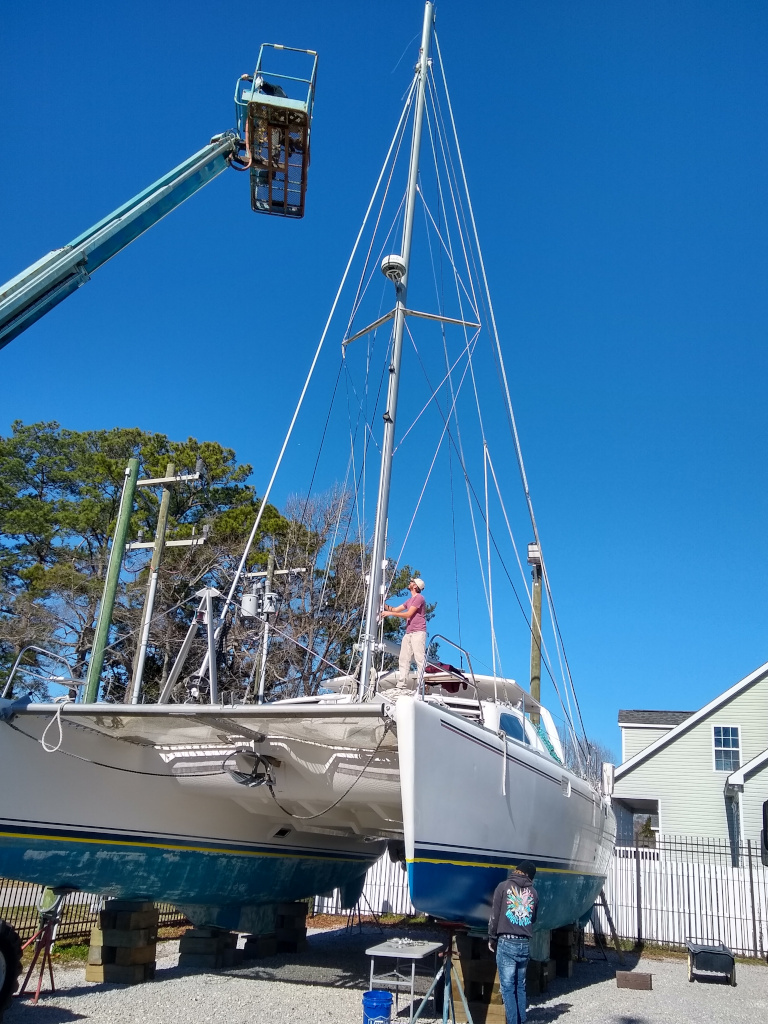
New rigging and bottom paint


During the trip up to New Bern, I found that one of the shaft seals was leaking a bit. I also found some wear of the cutlass bearings during my out-of-water inspection. So, I pulled both props, bearings, seals, and prop shafts. The shafts were cleaned, inspected, polished, and reinstalled with new shaft seals and bearings. Both props were cleaned and painted with cold galvanizing compound (the same stuff Petit sells as prop coat...only at 1/3 the price) and reinstalled with new zincs. The motors were then re-aligned with the prop shafts.

While at the yard, I also had the chance to replace the last of the fluorescent fixtures in the cabin with new dimmable LED fixtures. Unfortunately the puck lights I ordered to replace the main cabin lights were a little too large so I donated them to my friends at The Retirement Project. At least the bulbs in the existing fixtures are already LED. The raw water strainers for the air conditioning units that were failing (the baskets were breaking apart and replacements were impossible to find in the US) were also replaced with brand new strainers. 

The boat was splashed last Monday, and after spinning up the motors and checking for leaks, the boat left the yard in much better mechanical condition than when it arrived.  

With all the problems getting reliable marine services and parts in Southport, and the fact that my slip rental was doubling in price with an expected 50% additional increase in a year, I have decided to change the home base for Rover. I was able to find a marina near the boatyard where we were hauled out at the same rate we were initially paying at the old marina before the price increase. The marina doesn't have a pool, but it also doesn't have a ferry blowing its horn at 5:30am or rocking the boat every half hour. Being a bigger town, it is also much easier to find any needed parts and supplies.  The facility is simple but nice with several showers, a boaters lounge, and laundry. The docks are floating with large steel pilings and a wave attenuator that seems to do a really good job of keeping the water inside the marina calm.  The harbormaster and his assistant are really nice folks, are happy to help with anything you need, and they seem to keep up with maintenance.  I'm looking forward to having my boat here. 

And a new home.


Monday, January 5, 2015

Lots of Learnin'

Since the beginning of the year most of the "work" I've been doing on the boat falls under the category of learning.  I've got a number of projects that I would like to accomplish and all of it is stuff I really know nothing about, so I've been spending a lot of time Googling these various projects.

The first project is one I started in December.  I would really like to replace the fabric bimini top on the boat with a hard top.  There are a number of advantages to having a hard top.  First, I won't need to deal with replacing the fabric on a semi-regular basis as the sun takes its toll on fabric and sewing of the top. More importantly, it provides a wide and stable platform for working with the main sail boom, something I consider to be a safety enhancement.  It will also be a nice platform for mounting solar panels.  And there is no point in creating a new set of dodgers for my current top if I intend to replace it.  So, I've been talking with a guy in town about options for creating a simple hard top and looking at other designs for ideas on getting one made for a reasonable cost.

RV, Marine Kit With 630 Watts of DC Power

Speaking of solar, that is also on the list of upgrades I would like to make soon.  Currently, the only ways I have to keep the batteries charged on the boat are to run the engines, run the diesel generator, or plug it into shore power.  Since I would like to spend more time out of marinas and on anchor (and not have to burn lots of diesel), I need a greener way to keep the batteries topped off and solar power seems like the best option.  Having a catamaran, and particularly one with a hard top bimini, provides a lot of space to install solar.  Recently Kyocera came out with some solar panels that produce up to 325 watts of power at 40 volts DC and they are reasonably priced.  With the right maximum power point tracking (MPPT) controller, two of these panels could produce somewhere in the neighborhood of 240 Amp Hours of juice a day.  So, I've been looking at solar packages similar to this one to add to the boat.  I also performed a power inventory to see how much power I think I will need in a day.  Of course, a lot of this is still guess work as I don't have really good numbers for how we will be using power.  Things like the refrigerator (one of the big power hogs) is easy, but other lifestyle uses are still somewhat unknown.

I also need rebed both of the large salon side windows on the boat.  It seems that Leopard didn't have a good process or didn't use the best materials when they were originally installed. The result is a failure rate on the seals on the windows on most of their older boats is near 100%.  The windows have no mechanical fasteners and are only held in by sealant.  So, I've spent a lot of time looking through all the questions and pictures on the Leopard owners group on Yahoo.  It sounds like a bit of a tedious and messy process, but I think I have a handle on it.  Guess I'll find out soon as the sealant needed should arrive later today.  Then I just need a couple warm dry days to do the work.


One other task has popped up that I wasn't planning on.  When I was showing a fellow Leopard 3800 owner at the marina my new Mantus anchor, we noticed that the fiberglass structure that the anchor roller is mounted to has started to crack.  The roller and bail now move some when they shouldn't move at all.  Since this area takes a lot of load while anchoring, it will need to be repaired.  So, with my very limited knowledge about fiberglass repair, I've been researching that as well.  Looking at the other Leopard, his boat has a significantly thicker fiberglass structure than mine, so I guess someone might have figured out an issue with the boat in between when mine was built and when his was.  In any case, looks like I'll be doing some pretty serious fiberglass layup work in the near future.

So, filling my head with boat fixing knowledge, hopefully I can execute some of it well.

Tuesday, October 8, 2013

Leopard 38 Survey and Sea Trial - Second Attempt

We didn't get back to the hotel in Marathon from our pre-sea-trial repositioning sail until around midnight. Fortunately, the rescheduled haul out wasn't until the afternoon, so we did sleep in a little bit. We checked out of the hotel just before 11 am and made our way back to Key West.

We met our broker, Pete, and briefed him on the prior days trip. He had been worried when he hadn't heard from us last night (until my 10pm text that we had indeed made it). I think his biggest worry was (since he knows I'm not one to put up with a lot of B.S.) that something might come up between me and the selling agent and some of her, shall we say, creative explanations. No worries Pete, I'm pretty sure I can restrain myself from pushing someone overboard...and we all got along fine (except for a couple minor spats between the selling agent and the hired captain).


We moved the boat over to the marina lift and...YES, it fits. We walk the boat into the lifts slip and up she goes.

Haul-out at twice normal speed.  This video has been stabilized by YouTube
to see the original shaky one (with out the wavy artifacts) click here.

Then begins the process of evicting the sea creatures from the boat's bottom.

Boat bottom or coral reef, you decide.
A "little" scraping and a pressure wash.
Not perfect. but way better.

After the cleanup, Jonathan does his inspection and sounding (tapping the hull with a hammer) looking for delamination and water penetration issues. It really is amazing what you can see with the boat in the lift straps that you cannot see when it is in the water...even the parts of the hull that sit above the waterline.

We did find one large patch in the forward hull that was of some concern, and a number of chips down to the fiberglass that will need to be touched up as well as some other odds and ends, but it was definitely more positive than our last hull inspection that sank that deal.

After the hull inspection, we put the boat back in the water for the official sea trial. Now one might think we got quite a sea trial the day before, but in addition to the sea trial being a bit of a test drive, it is also a chance for the surveyor to inspect the engines, sails and rigging under load. The winds were about the same as they were the prior day and we had seas in the 3 to 4 foot range and this made for a good sea trial. I was definitely a welcome change to see that the boat was able to do closer to half of the wind speed on a close reach with the cleaner bottom and no engine assistance. In fact, I was having enough fun with it that I was a bit disappointed when Jonathan said he was done and we could head back at any time.

Once we get back to the dock, there were a couple last checks that Jonathan had to perform.  He took oil samples from the engines to do an oil analysis* and to go up the mast to inspect the rigging.


By the time we are done, it is around 6pm on a Friday night. We very briefly talk about a few of the bigger issues with the boat, but to get the full report will take a little time and Jonathan needs to head back home.  Our AOV (Acceptance of Vessel - basically the last day I have to reject the purchase based on the survey, sea trial, and personal inspection) is tomorrow and there is simply no way I will have the report in that time.  So, the last thing we do is get with my broker to submit paperwork to the seller for an extension of the AOV so I will have time to review the results of the survey and make informed decisions.

And with that we begin our drive back to Ft. Lauderdale to check in to a hotel near the airport so we can make our early flight back home.  Yet again we fail to get to sleep before midnight...guess getting to bed early just wasn't going to happen this trip (well past the "cruisers midnight" that I assume will become part of our lives).

The AOV extension was accepted, now we just wait...impatiently...for the report from the surveyor. I know it will be a pretty long list, but hopefully not insurmountable.

*I know there is a great amount of debate regarding the usefulness of oil analysis...at least there is in piston aviation engines. If an engine is tearing itself apart the metal is often larger than what is caught in suspension in the oil.  I wonder if an oil filter inspection looking for metal would be a better option for surveyors to try (an inspection that is usually done in piston aviation engines).

Sunday, October 6, 2013

Leopard 38 Survey and Sea Trial

So, here we are, our second attempt at a survey and sea trial on a boat that we think could be ours. We arrived in Ft. Lauderdale on what is starting to feel like a regular commute except it was at midnight due to flight delays. Drove to a hotel in Florida City (so we would miss the morning traffic through Miami) and spent a few hours trying to get some sleep. We then continued on to Marathon for the 9am appointment at the boat. Of course, in true Florida driving fashion, our plan to miss traffic problems failed as someone managed to close the Overseas Highway by wrecking their car somewhere between Florida City and Key Largo. In the time we have spent in Florida we have seen quite a number of single car accidents on straight, flat roads in good weather and knowing the stretch of Highway 1, assume a similar situation has occurred. I do hope the people are okay.  Hmm...new business idea...maybe I should open a driving school...

We arrive at the boat a little late due to the extended commute time and find our surveyor was already there (he apparently made it through just before the accident that detoured us). He briefs me on the issues found thus far; some through hulls don't work, some electrical issues including the generator, and a laundry list of other items in addition to the stuff we already knew about. Apparently the owner's broker had one engine running when he arrived so he couldn't do the usual cold start checks on it, and the other engine wouldn't start so they had to call for a mechanic. The mechanic came, found the somewhat hidden breaker in the engine compartment and made a temporary fix to the alternator, and we were good to go haul out the boat.

Marathon Boat Yard Lift

We head over to the marina in Marathon where we were scheduled to do the haulout. When we get there, we look at the lift and wonder if the boat will fit. We had called to verify it would, the selling agent claimed Leopard 38s (maybe even this particular boat) have been hauled out here before and we did see a Manta on the hard in the yard, so we slowly ease the boat toward the haul out slip thinking it will be close but will hopefully fit. Well, guess what...it doesn't fit. The selling agent "tries a little harder" and wedges the boat between the bumpers...hope she didn't just damage the hull.  Have we just wasted a trip down to see a haul out that isn't going to happen?

After some phone calls, the selling agent finds the closest marina that claims they can haul out this beamy cat...but it is in Key West (the next best option is in Key Largo). The seller's agent then tried to tell my broker that we would need to help cover the cost to reposition the boat...which Pete quickly dismissed. It is the current owner's responsibility to provide the captain for the vessel as well as the costs for the sea trial and movement to an appropriate haul-out location and the buyer's (my) responsibility to pay for the costs of the haulout and surveyor (as stated in the contract). After getting everything squared away, the agent and captain might just have time to sail the boat down for a haulout the next afternoon.

Since the only reason we were in Florida was for the survey and sea trial and we had nothing better to do, we asked if we could tag along for the sail down to Key West. Just trying to make a little lemonade from the lemons we've been handed. They agreed, so the captain grabbed some provisions (sandwiches and water) and did some checks and made the boat ready for a short coastal trip. The current owner also decided to come along. So, the 5 of us head off to Key West.

Have I mentioned that this boat had been sitting in the water but had not been sailed in quite a while?

If this is a dockline, wonder what the bottom looks like
My broker and surveyor as well as I wondered how successful this attempt to reposition a boat that had not been used in a while would be, but did agree that it would also be a great opportunity (and pretty rare chance in boat buying) to really get comfortable with the boat. When we started moving the boat, it left a trail of the aquatic life attached to its hull in its wake. Someone joked that we might need to get a permit for messing with a marine habitat in order to clean the bottom. It was one dirty bottom boat, a fact that was confirmed by the 8 hours it took to make the trip from Marathon to Key West with an average speed of just about 5 knots using both the engines and sails on a very broad reach.


Toward the end of the trip, when the captain was looking for a whisker pole that the owner once thought was on board, he discovered an asymetrical spinnaker sitting under some chain in the anchor locker. Other than a rust stain (no idea why it was stored there... but if you have a boat, remember that the appropriate place to store a sail is not under a rusty chain in an anchor locker...the chain does not need a multi-thousand dollar pillow) it was in good shape, so we decided to give it a whirl to expedite our progress. Between the bits of reef that we were slowly knocking off the hull and the light air sail (the captain and selling agent had a disagreement over the precise type, so we nicknamed it bigsail [pronounced bigs'l] because it sounded less pretentious that way), we did manage a little over 6 knots toward the end of the sail with winds estimated around 15 knots. We arrived in Key West just a bit before 10pm. I'm not exacly sure when we left, but estimate it was a 7 to 8 hour sail.

So around 10 pm, we start the drive back to Marathon to check into the hotel for the night. Looks like it will be after midnight before we have a room for the second day in a row on this trip. Tomorrow, the haulout and official sea trial will hopefully occur.

While the inability to complete the survey today is a disappointment, I do have to say that I really, REALLY appreciate that those working on my behalf have been so great in the face of these frustrations.  Both Pete my broker and Jonathan my surveyor have had to deal with this extra day for the survey.  The surveyor has an appointment so he has to drive back to Ft. Lauderdale and then return to Key West tomorrow afternoon.  My broker had to change his plans so he could spend the night in Key West.  And both have been there to cover my back when needed. Still can't say enough nice things about these guys.

Update: Unfortunately I can no longer recommend either the broker or the surveyor mentioned in the above post.